Digital marketing in 2026 looks completely different from what it was two years ago. Search engines now show summaries that are created by AI right on the results page.
Introduction
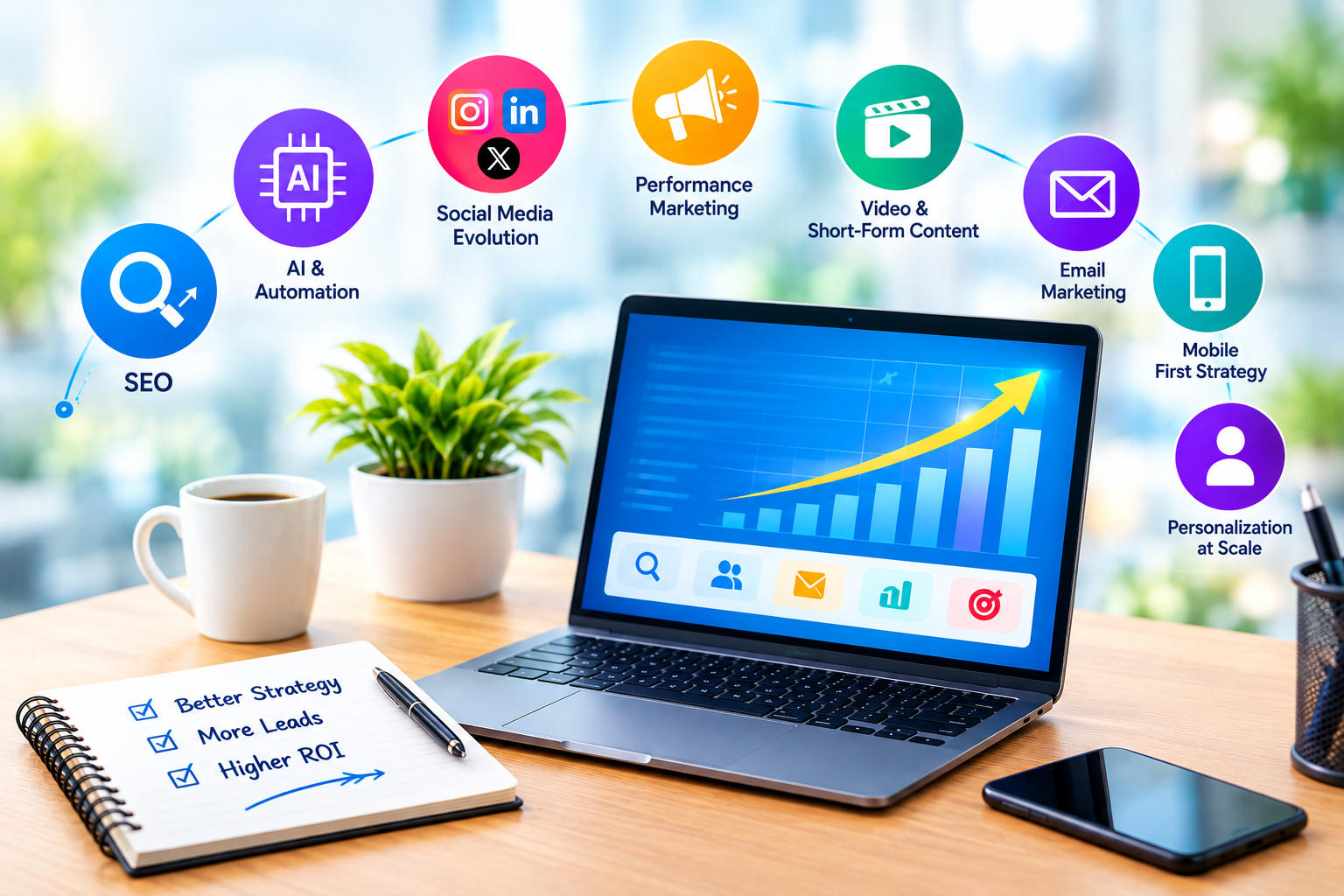
Digital marketing in 2026 looks completely different from what it was two years ago. Search engines now show summaries that are created by AI right on the results page. Buyers don’t make decisions quickly. They research on five or six touchpoints before they decide to buy. At the same time, privacy rules have quietly made it much harder to track people and target audiences. It’s a new world for digital marketers. For any brands trying to scale in the digital space, staying ahead of the trends is essential.
In this post, we unpack what the trending digital marketing trends are for 2026, which digital marketing strategies to focus on, and how both local and national brands are shifting their approach to adapt.
The Biggest Shift: AI Is Now Integrated into the Search Experience
Search behaviour has shifted. People don't go down the ten blue link rabbit hole, anymore. Now they look to get the answer to their query first, displayed above the search results page; sometimes before they even click on a website. So brands must shift their content approach too because ranking alone is no longer enough. In the future content must be written clearly that AI can understand it and cite it.
Practically this means: publish content that answers questions directly instead of putting answers deep inside long.
Employ descriptive titles, FAQ segments, and content organization/schema markup that facilitates easier parsing by search engines and human models. Create topical authority on a topic, not search keywords individually
Treat AI as a new distribution channel. Companies embracing AI Overviews and AI-assisted search as just another distribution channel - not a workaround threat - are getting the highest visibility lifts this year.
Local SEO Is More Competitive Than Ever
With so many advertisers dabbling in online marketing, local search is getting competitive in the average city, too. A business that used to rank well for "near me" searches is now fighting dozens of similarly optimized and targeted listings.
What's working in 2026:
Regular and thorough Google Business Profiles with current photos, services and consistent posting
Systems that generate reviews proactively rather than passively getting reviewsPages for specific places focused on neighborhoods, service areas, or other regional use cases rather than relying on traditional city-wide pages
Local business schema markup, so that AI tools and search engines can learn more precisely where a business is and what it provides.
For service-related businesses specifically, neighborhood SEO rankings are generally more important than general national rankings, as your customers will generally be searching with the intent to buy from your specific geographical area.
Short-Form Video Remains a Key Channel – But the Strategy Has Evolved
Short-form video isn't a new format, but the approach is changing. Reposting the same video on each platform isn't resonating as well as it used to. What's in demand is platform-specific content - a version of your video edited for Instagram Reels and a different one for YouTube Shorts, each optimized for the audience on that platform.
Brands are also adopting short-form video even earlier in the funnel, using it to not only entertain, but to ask and answer common customer questions, demonstrate behind-the-scenes production or service execution, and create a foundation of trust prior to a customer ever arriving on your site.
First-Party Data Is No Longer Optional
As third-party cookies are blocked, restricted or deleted by ever more systems and regulations internationally, advertisers' current ad networks are also less able to simply track audiences around the web to re-target advertising, even if the advertisers don't have those users' explicit data on their websites or apps. This places first-party data (CRM, email addresses, and consented online activity) at the centre of modern business.
Why Working With a Specialist Still Matters
Things are changing so quickly with these platforms - search engines, AI results, privacy policies and platform behaviour all changing at the same time - that most companies find it easier to work with a dedicated digital marketing agency in Pune or their local area than to handle this all in-house. A digital marketing agency in Pune that specialises in this work will have more experience in SEO, paid media, content and analytics and can respond to changes in the platform more readily.
If you're a business shopping around for digital marketing services in Pune, the best partnerships will typically be those where someone is taking strategy as a continual process - learning from search and conversions month by month, keeping up-to-date with what's happening in search and AI Overviews - rather than simply building out a plan and dropping it. Of course, in addition to your core SEO, your content marketing, local SEO, CRO and online reputation management strategies will all usually be recommended as a collective set of activities.
Building a 2026-Ready Digital Marketing Strategy
Here are some key areas to focus on as you formulate your strategy this year:
Test your content for AI-readiness- well-structured, straight-to-the-point content ranks well in organic search and Overviews. Deepen your knowledge of local SEO basics- Google Business Profile, reviews, and local schema are basic and essential.
Build first-party data - email and CRM systems are now foundational marketing tools, not supplemental backup options. Mix it up - Video, written content and tools all play a different role in the customer journey.
Monitor AI-powered mentions see if your company is mentioned in answers that come from an AI, not just your position on a results page.
One thing is certain: Digital marketing success in 2026 will come down to the agility of your response to consumer searching and discovery - today's results driven by AI-assisted search, hyper-local search, and multiple types of content. Those who use data‑based strategies right now will be far more likely to succeed as these trends speed up.
Frequently Asked Questions
What is the leading digital marketing trend of 2026?
The biggest change that search is experiencing is a shift to AI‑enabled search. In this search style the list of choices on a page will be replaced by a chat‑style summary of answers. This shift is a part of the digital marketing trend for 2026. Therefore, businesses must adjust their content to suit AI sourcing and referencing.
Does local SEO still matter for businesses in 2026?
Yes, local SEO still matters for businesses in 2026 and it matters more than ever. This is especially true as businesses contend with growing competition in search results. A well‑optimized Google Business Profile, reviews and content that is tailored to the local area are vital.
Why Use an agency? Why would you choose to outsource your marketing to a digital marketing agency?
A digital marketing agency covers a range of ever-changing areas - SEO, AI search optimization, paid media, content, and data privacy compliance. Typically, the digital agency will have specialists in each area and can move agilely when the strategy shifts, unlike an internal team.
How has AI impacted your SEO strategy?
AI is now taking the form of a search that involves answer snippets as well as what we used to call a search.
Post Your Enquiry
Your email address will not be published. Required fields are marked *